

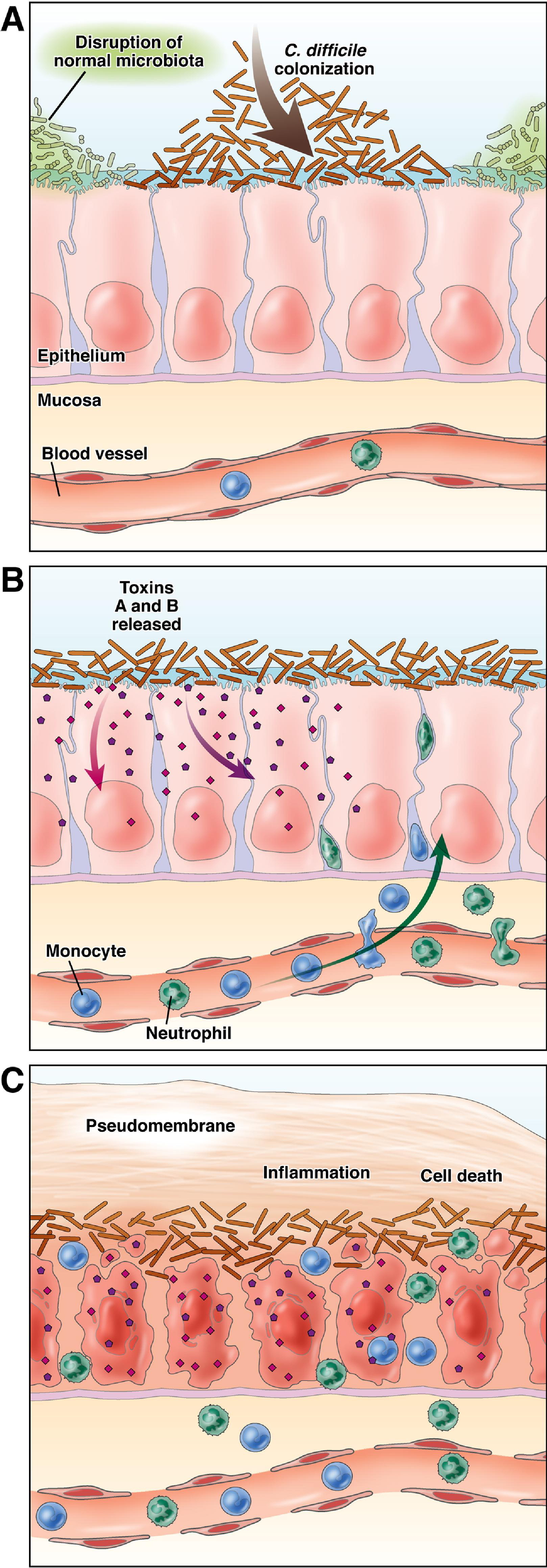
Clostridium difficile is a Gram-positive, spore-forming, anaerobic bacillus that can produce toxins. The disease formerly known as C difficile-associated disease (CDAD) is now called C difficile infection (CDI). CDI ranges in severity from mild diarrhea to fulminant colitis. Risk factors for CDI include antibiotic use within three months prior to symptom onset and exposure to spores in a health-care setting.
Antibiotic use is the primary risk factor for CDI. Clindamycin, fluoroquinolones, cephalosporins, and carbapenems are associated with the highest risk of CDI.
After ingestion of spores, the intestines can become colonized with Clostridium difficile. In healthy individuals, gut bacteria, bile-acids, and the immune system suppress spore germination. However, alterations of the gut microbiome by antibiotics can lead to C. difficile overgrowth and toxin production, converting asymptomatic colonization into symptomatic infection. Toxins A and B bind to colonic epithelium causing inflammation and cell death, leading to diarrhea and colitis. Symptoms of CDI range from mild infection with diarrhea to fulminant colitis.
Common nonspecific laboratory abnormalities that accompany CDI include leukocytosis and hypoalbuminemia. Fecal leukocytes are detected in 50-60% of cases. Gram stains of fecal specimens are of no value, since C. difficile is only a small part of the fecal flora, even among patients with severe colitis. Likewise, anaerobic stool cultures are of little use in the diagnosis, due to the inability to distinguish between toxigenic and nontoxigenic strains.
Diagnostic tests for CDI include toxin enzyme immunoassays (EIA) that detect free toxins, PCR which detects C. difficile genes, and glutamate dehydrogenase (GDH) EIA. The latter detects the GDH protein which is present in both toxigenic and nontoxigenic C difficile. PCR targets the tcdA & tcdB genes that encode for toxins A and B.
PCR has a higher sensitivity for diagnosing CDI than toxin EIAs, 95% vs 83%, but have lower specificity, 94% vs 99%. A negative PCR result rules out CDI, but a positive result does not distinguish between colonization and CDI. The European Society of Clinical Microbiology and Infectious Diseases recommends combining a sensitive screening assay, such as PCR or GDH EIA, with a highly specific toxin EIA.
Negative PCR or GDH EIA results reliably exclude CDI because they have a negative predictive value of 98%. Patients with a positive toxin EIA are likely to have CDI. Patients with a positive PCR or GDH antigen result and a negative toxin EIA result may have symptomatic CDI or may be asymptomatic carriers of C difficile.
Screening tests should only be ordered for patients with unexplained new-onset diarrhea (defined as 3 or more unformed stools in 24 hours) who are not taking laxatives. Patients with recent CDI without recurrent symptoms should not be tested.
Unformed stool specimens should be submitted fresh (refrigerated unless transported to the laboratory immediately) or in Cary-Blair transport media.
References
McCollum DL, Rodriguez MJ, Detection, Treatment, and Prevention of Clostridium difficile Infection, Clinical Gastroenterology and Hepatology, 2012; 10, 581-592.
Nicholson MR and Donskey CJ. Multistep testing algorithms for Clostridioides difficile infection. JAMA Sep 12, 2023; 330:966-967.
DiBella S, et al, Clostridioides difficile infection, Clin Microbiol Rev, 2024;37(2):e0013523.
Van Prehn J, Kuijper EJ, Dubberke ER, Recurrent Clostridioides difficile Infections, JAMA 2025;334(23):2128-2129.
McDonald CC et al. Clinical practice guidelines for clostridium difficile infection in adults and children: 2017 update by IDSA and SHEA. Nephrol Dial Transplant 2018;66(7)e1-e48.
van Prehn J, et al, European Society of Clinical Microbiology and Infectious Diseases: 2021 update on the treatment guidance document for Clostridioides difficile infection in adults Clinical Microbiology and Infection, 2021; 27, S1-S21.


 How to resolve AdBlock issue?