

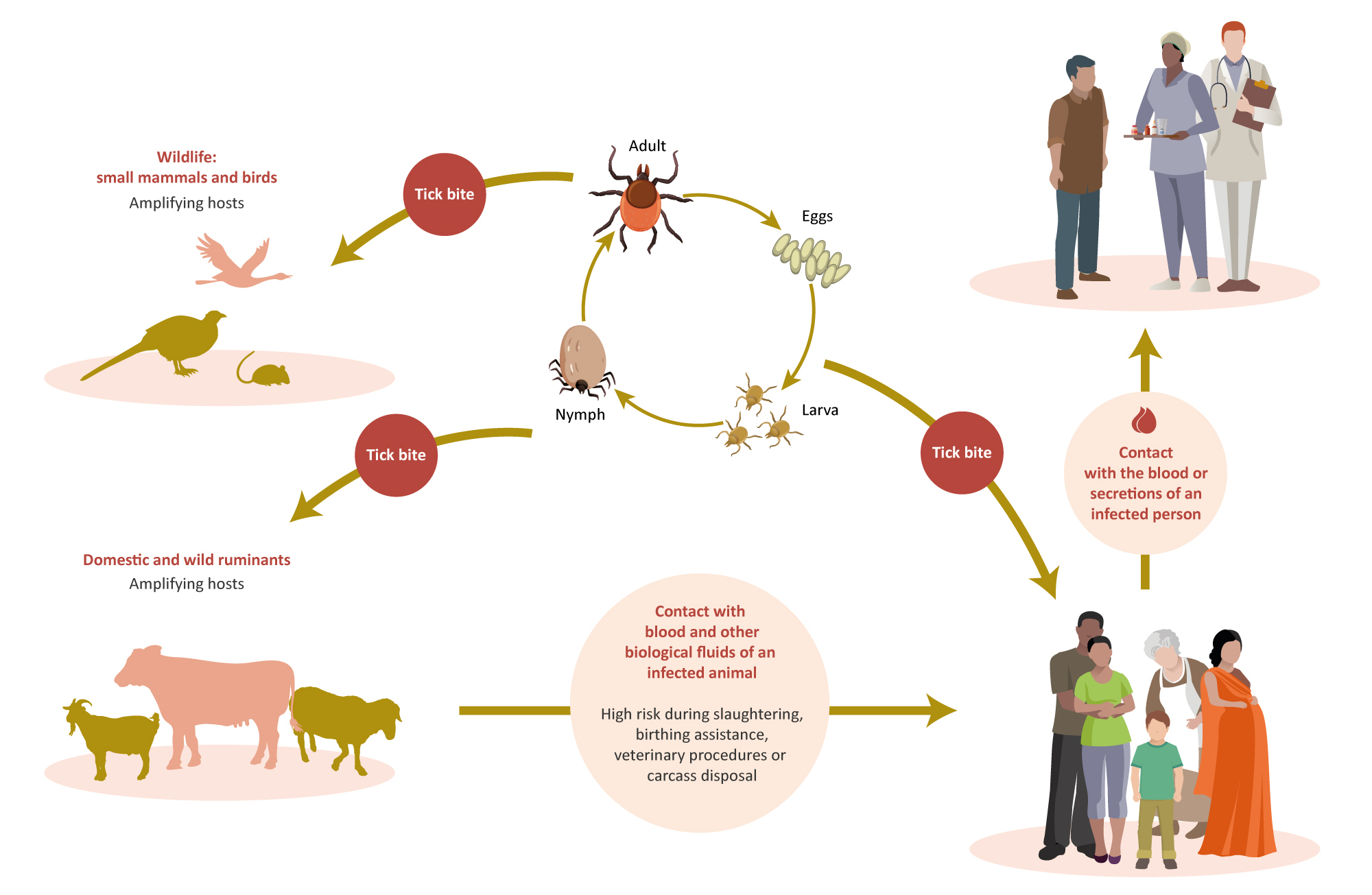
Crimean-Congo hemorrhagic fever (CCHF) is a widespread disease caused by a tick-borne virus (Nairovirus) of the Bunyaviridae family. The CCHF virus causes severe viral hemorrhagic fever outbreaks in Africa, the Balkans, the Middle East and Asian countries south of the 50th parallel.
Hyalomma marginatum is the tick that serves as the principal vector of the CCHF virus.Unlike ticks that passively wait on vegetation for a passing host, Hyalomma is an active hunter that can travel hundreds of meters in search of cattle, sheep, goats or ostriches. Animals become infected by the bite of infected ticks. The virus circulates in their bloodstream for about one week after infection, allowing the tick-animal-tick cycle to continue when another tick bites.
Because of climate change, CCHF virus is spreading across the European continent. Hyalomma ticks have arrived in northern Europe on migrating birds for decades, but usually encountered conditions too harsh to complete their life cycle. However, climate change is producing higher temperatures and longer summers that increase the likelihood that immature ticks will develop into adults and establish local populations. Hyalomma ticks have been reported at least once in 40 European countries. The CCHF virus has been detected in ticks in Spain, Portugal, and France.
CCHF virus is transmitted to humans either by tick bites or through contact with infected animal blood, tissues, or body fluids. The majority of human cases involve people in the livestock industry, such as agricultural workers, slaughterhouse workers and veterinarians.
The length of the incubation period varies with the mode of transmission. Following infection by a tick bite, the incubation period is usually 1 to 3 days, with a maximum of 9 days. Following contact with infected blood or tissues, the incubation period is usually 5 to 6 days, but can be as long as 13 days.
Symptom onset is sudden and includes fever, myalgia, dizziness, neck pain and stiffness, backache, headache, sore eyes, and photophobia. Patients may also experience nausea, vomiting, diarrhea, abdominal pain and sore throat. Within 2 to 4 days, patients my develop mood swings and confusion followed by sleepiness, depression, and lassitude. Abdominal pain may localize to the upper right quadrant, following the development of hepatomegaly. A petechial rash involving skin and mucosal surfaces may progress to ecchymoses. Hepatitis may progress to liver failure. Hemorrhage can lead to kidney and pulmonary failure usually after the fifth day of illness. The mortality rate from CCHF is approximately 30%, with death occurring in the second week of illness. In patients who recover, improvement generally begins on the ninth or tenth day after the onset of illness.
There is no specific treatment for CCHF. Ribavirin has been given off-label, but its efficacy has not been proven. Supportive care includes fluid management and treatment of specific symptoms.
CCHF virus can be detected by enzyme-linked immunosorbent assay (ELSA) and reverse transcriptase polymerase chain reaction (RT-PCR).
References
Hawman DW, Feldmann H, Crimean-Congo haemorrhagic fever virus, Nat Rev Microbiol. 2023;21(7):463-477.
Gargili A, et al. The role of ticks in the maintenance and transmission of Crimean-Congo hemorrhagic fever virus: a review of published field and laboratory studies. Antivir. Res. 2017;144:93–119.
Lindeborg M, et al. Migratory birds, ticks, and Crimean-Congo hemorrhagic fever virus. Emerg. Infect. Dis. 2012;18:2095–2097.
Stone R. Deadly tick-borne virus gains ground in Europe as climate warms, science.org, August 21, 2026


 How to resolve AdBlock issue?