

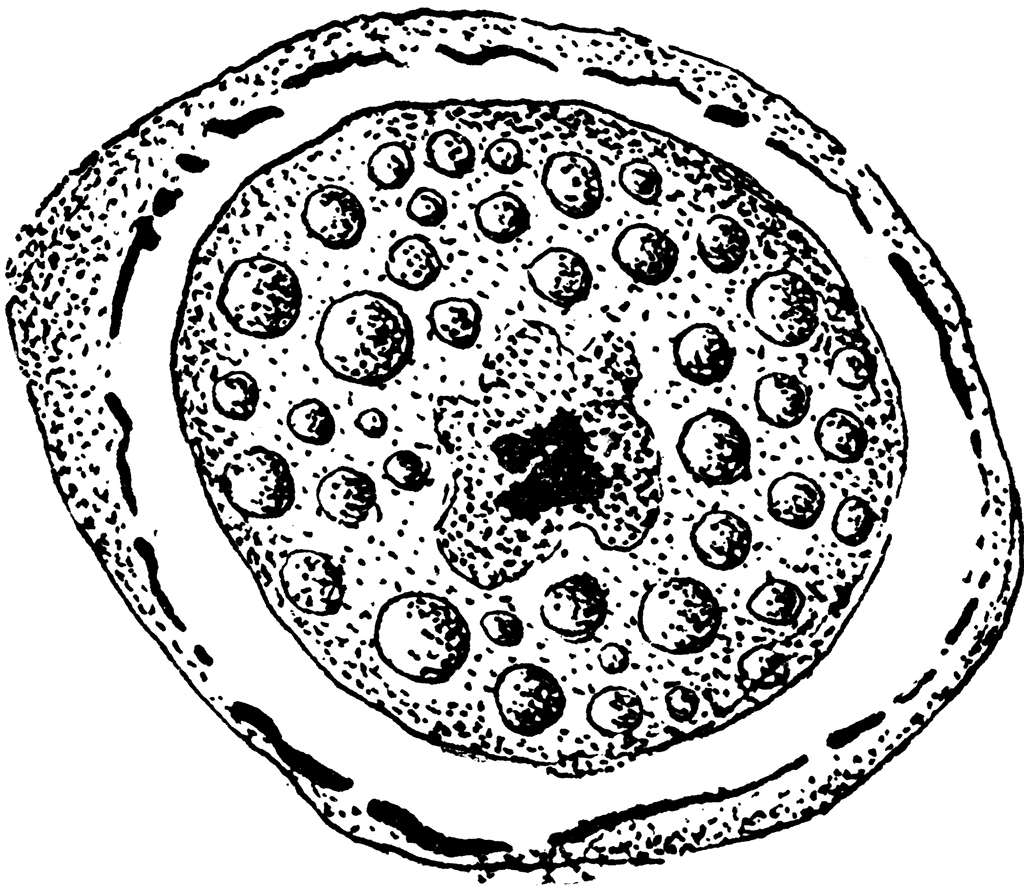
Cyclosporiasis is an intestinal illness caused by the unicellular, coccidian parasite Cyclospora cayetanensis. Transmission occurs by ingestion of food or water contaminated with human feces. Humans are the only known hosts of this parasite. Cyclosporiasis season typically occurs between May 1 through August 31.
Cyclosporiasis is most common in tropical and subtropical regions of the world such as Mexico, the Caribbean and Central America. In the United States, cases of cyclosporiasis have been reported among travelers to such areas. Cyclosporiasis became a nationally notifiable disease in the US in January 1999 after several large multi-state outbreaks. The United States typically records between 3,000 and 4,000 cases per year. As of September 17, 2026, there have been 7 outbreaks involving 36,510 cases in 48 states. Five percent of these cases have required hospitalization.
The majority of Cyclospora cases have occurred from a 15-state outbreak associated with tainted lettuce grown in Central Mexico. In June 2026, a large outbreak of Cyclosporiasis occurred in Indiana, Kentucky, Michigan, Ohio, and West Virginia. On July 16, 2026, the FDA announced that 90% of people who became ill reported eating at Taco Bell restaurants in these states during the prior 10 days. The FDA then reported that Taylor Farms de Mexico had supplied shredded iceberg lettuce to these Taco Bell restaurants. On July 17, Taylor Farms recalled its iceberg lettuce from Taco Bell and Jack in the Box restaurants, Walmart, and food service distributors (such as Sysco) in 27 states.
As of September 10, Michigan had confirmed 14,718 cases, 366 hospitalizations and 2 deaths. Ohio had confirmed 6,063 cases and 172 hospitalizations. On July 24, FDA reported that the Cyclospora outbreak linked to iceberg lettuce from Taylor Farms had expanded to 4 more states including Illinois, Kansas, Oklahoma, and Pennsylvania.
By August 5, the CDC said the cyclosporiasis outbreak associated with contaminated lettuce from Taylor Farms de Mexico had reached six more states (Arkansas, Iowa, Missouri, Nebraska, New Hampshire, and North Carolina) bringing the total to 15 states.
Taylor Fresh Food Inc sells more than $7 billion in produce annually and makes more than 40% of prepackaged salads in the United States. Taylor Fresh Food instructed Taylor Farms de Mexico (located in Guanajuato, Mexico) to remove all iceberg lettuce from the U.S. market.
According to an FDA Enforcement Report, Taylor Farms recalled 236,192 cases of lettuce that had been distributed to 27 states from June 29 through July 16. The affected states included: Alabama, Arkansas, Connecticut, Florida, Georgia, Iowa, Illinois, Indiana, Kansas, Kentucky, Louisiana, Massachusetts, Maryland, Michigan, Missouri, Mississippi, North Carolina, New Hampshire, New Jersey, Ohio, Oklahoma, Pennsylvania, South Carolina, Tennessee, Texas, Virginia and Wisconsin.
Only 2.5% of the recalled lettuce went to Taco Bell. Almost half of the recalled lettuce was supplied to Walmart. Smaller amounts were distributed to Subway, Jack in the Box, US Foods, Markon, Performance Food Service, and Sysco.
In January of 2025, Taylor Farms hired a lobbyist to delay implementation of the Food Traceability Rule. This food safety regulation was supposed to go into effect on January 20, 2026. On March 20, 2025, FDA announced it was delaying implementation of the Food Traceability rule by 30 months. Six days later, Taylor Fresh Foods Inc contributed $1 million to MAGA Inc, a Trump-aligned super PAC. It was the company’s first donation to any Trump-aligned committee. Taylor Fresh Foods gave another million dollars to the Congressional Leadership fund in June 2025. CEO Bruce Taylor is a major Republican donor personally but has never given directly to a Trump-aligned committee.
The FDA conducted on-site inspections of farms and processing facilities that provided lettuce distributed by Taylor Farms de Mexico. They found two samples that tested positive for Cyclospora. One sample was from a tank at a processing facility that held outgoing wastewater. The second sample was from drainage ditch of an iceberg lettuce grower.
On October 2, 2026, the FDA announced it had closed its investigation into cyclosporiasis outbreak associated with iceberg lettuce grown in Mexico. CDC previously declared the outbreak over on September 11, 2026.
This outbreak expanded unabated for several reasons including the lack of centralized coordination by the federal government, the US’s siloed health care systems, and insufficient resources at state and local health departments. CDC has not been able to provide up-to-date national data regarding Cyclospora outbreaks. Neither the CDC or the FDA has a permanent director and both agencies have lost staff and testing capacity. Federal workforce reductions at the CDC cut the parasite surveillance team from 11 personnel to 3.
On July 1, 2025, FoodNet, the main food-borne illness surveillance arm of the CDC, reduced the number of pathogens it tracks to two, Salmonella and Shiga toxin-producing E. Coli (STEC). Since then, states were no longer to required to report food-borne illnesses occurring from Campylobacter, Cyclospora, Listeria, Shigella, Vibrio, and Yersinia. Consequently, This policy change weakened the national surveillance capacity that would have allowed for earlier detection of the cyclosporiasis outbreak.
Also in April 2025, the FDA suspended the proficiency testing program for the national food testing laboratory network. A quality assurance officer, a chemist and two microbiologists were laid off. This program sent blind samples to participating laboratories to determine if they could accurately detect food-borne pathogens.
On November 13, 2025, Congress passedH.R. 5371: Continuing Appropriations, Agriculture, Legislative Branch, Military Construction and Veterans Affairs, and Extensions Act, 2026. Section 780 of this act stated that no appropriated funds could be used to administer or enforce the traceability rule prior to July 20, 2028.
On July 14, 2026, the CDC issued a Health Alert Network Health Advisory to notify clinicians, public health practitioners, and laboratorians of cases of domestically acquired cyclosporiasis in multiple states.
On September 11, 2026, the FDA declared an end to the iceberg lettuce-related outbreak of Cyclopora that originated in central Mexico and was recalled by Taylor Farms de Mexico.
Cyclospora oocysts are not killed by the routine chemical disinfection or sanitizing methods used by food processors. The Food Safety Modernization Act Produce Safety Rule does not require growers or food processors to test for this parasite.
Food-borne outbreaks occur in the United States almost every year from May through September. Produce usually becomes contaminated at the farm or irrigation source and is then distributed to stores. The most commonly contaminated fresh produce includes basil, cilantro, lettuce, raspberries, snow peas and prepackaged salad mix. Washing produce reduces the risk of infestation, but does not eliminate it. Cooking food to an internal temperature of 158 degrees Fahrenheit kills oocysts, so cooked vegetables are a safer choice during outbreaks. Food must be frozen at -4 degrees Fahrenheit for at least 2 days to kill them.
Cyclospora inhabits the small intestine. Cyclospora infection can be asymptomatic or symptomatic. Asymptomatic infection is most common in endemic regions. Among persons who develop symptomatic Cyclosporiasis, the incubation period ranges from 2 to 14 days after exposure. Symptoms include explosive watery diarrhea, loss of appetite, weight loss, abdominal cramping, bloating, nausea, fatigue, vomiting, and low-grade fever. The recommended treatment for cyclosporiasis is trimethoprim-sulfamethoxazole (Bactrim) for 7 to 10 days. Without treatment, symptoms can follow a remitting-relapsing course that can last for a month or longer. Complications can include malabsorption, cholecystitis, and reactive arthritis. Cyclospora does not spread from person to person.
Routine ova and parasite examinations of stool typically do not detect Cyclospora oocysts. They are detected with a modified acid-fast stain or a modified safranin stain. The latter stain has better sensitivity. Oocysts appear clear to pink and refractile. If the ova and parasite exam fails to detect oocysts and Cyclospora infection is strongly suspected, molecular testing can be performed. The FilmArray Gastrointestinal Pathogen Panel utilizes nucleic acid amplification to detect multiple viral, bacterial and parasitic pathogens including Cyclospora. Qiagen’s QIAstat-DX Gastrointestinal panel 2 is a syndromic assay that detects 16 pathogens including Cyclospora.
Stool specimen is required for testing. Reference value is negative. Laboratories are required to report positive Cyclospora results to the CDC.
References
Casillas SM, Hall RL, Herwaldt BL. Cyclosporiasis Surveillance — United States, 2011–2015. MMWR Surveill Summ 2019;68(No. SS-3):1–16.
Visvesvara GS et al: Uniform staining of Cyclospora oocysts in fecal smears by a modified safranin technique with microwave heating. J Clin Microbiol 1997;35:730-733).
Goetzman J, Carter A, Oliveira A, Ingram LA. Outbreak of Cyclosporiasis Among Patrons of a Mexican-Style Restaurant — Limestone County, Alabama, May–June 2023. MMWR Morb Mortal Wkly Rep 2025;74:217–221.
Centers for Disease Control, Domestically Acquired Cyclosporiasis Cases in Multiple U.S. States, 2026, Health Alert Network, July 14, 2026, CDCHAN-00531.
Gounder C. Congress defunded the rule that finds the contaminated food, Underlying Conditions, celinegounder.com, August 5, 2026.


 How to resolve AdBlock issue?